Smith & Wesson M&P 380 Shield EZ Review: Is It Still the Best Handgun for Easy Operation?
Detailed hands-on review of the M&P 380 Shield EZ covering slide rack force, recoil, trigger performance, and defensive reliability for shooters with grip strength challenges.
OPINION
7/13/20265 min read
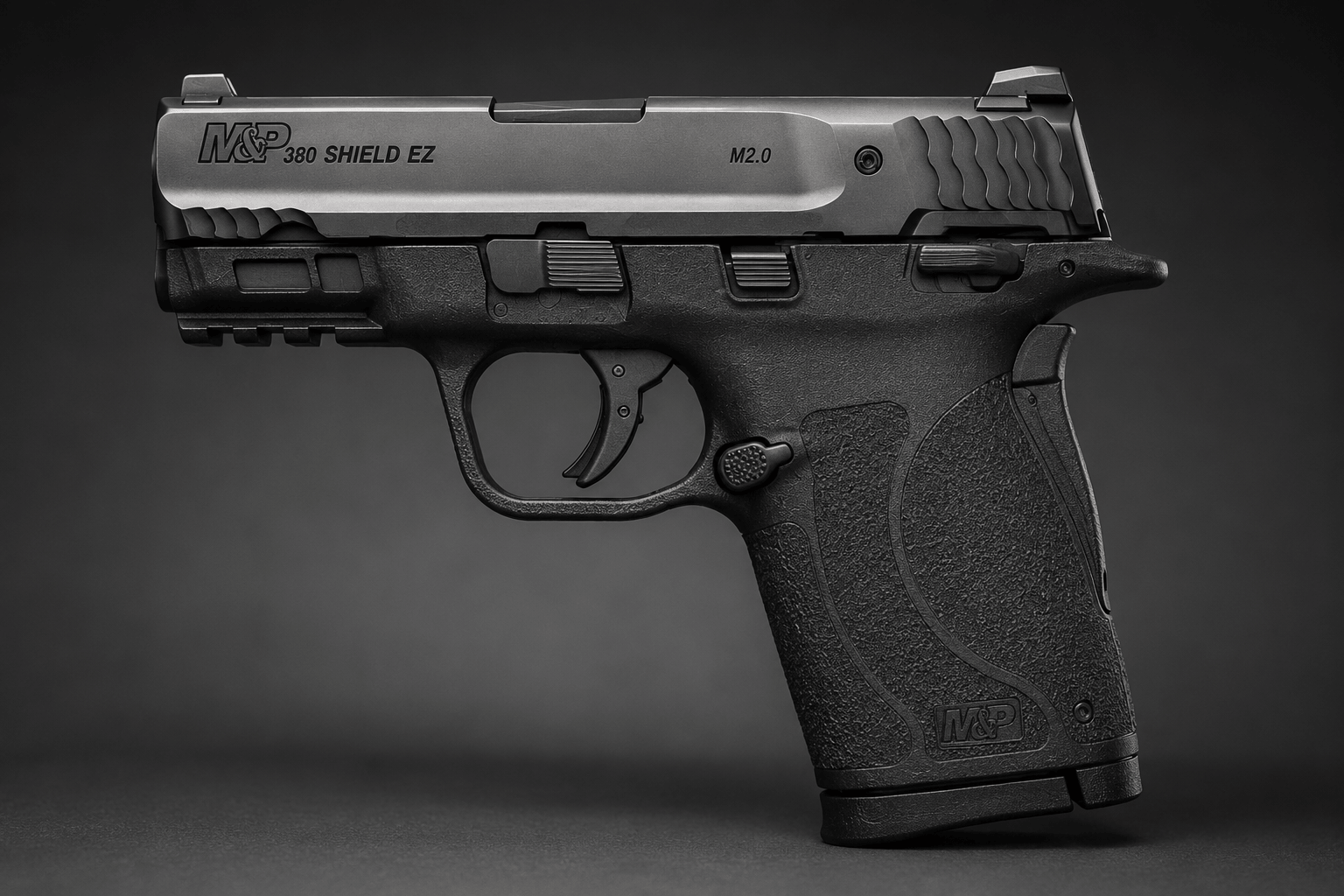
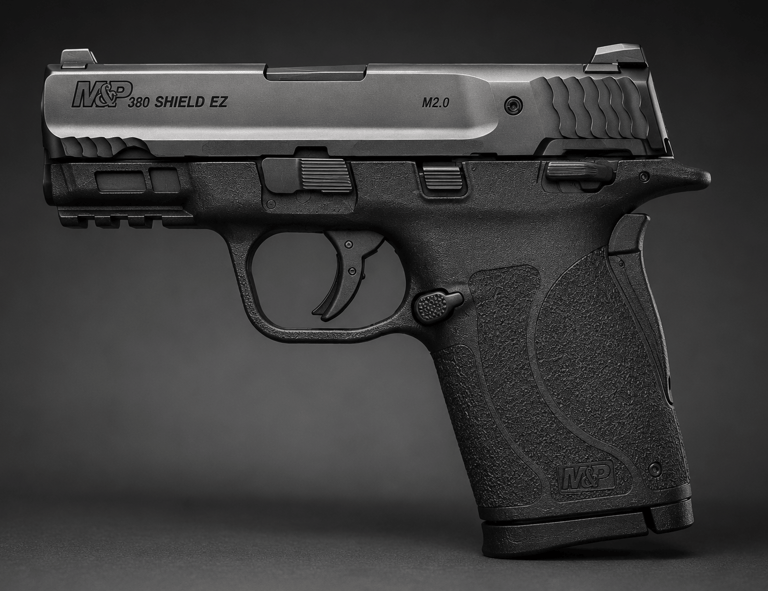
Smith & Wesson built the internal hammer-fired M&P 380 Shield EZ around one clear objective: solving the stiff slides, tight springs, and tough loading common to modern carry guns. To see how well it delivers, we put 500 rounds of mixed hollow-points and target loads downrange, measured the slide and trigger on a digital force gauge, and benched it directly against common micro-9s.
Slide Resistance Under 12 lbs: The slide cycles with minimal effort—pulling roughly half the resistance of typical striker-fired subcompacts.
Load-Assist 8-Round Mags: S&W borrowed the pull-down follower tab from .22 rimfire mags, sparing your thumbs when loading to capacity.
Minimal Felt Recoil: The polymer frame absorbs energy well, and paired with low-pressure .380 ACP rounds, muzzle rise stays flat and predictable.
Grip & Thumb Safety Setup: Features an active rear grip safety bar alongside available ambidextrous thumb levers for added reassurance.
Crisp Single-Action Break: The trigger consistently breaks clean between 4.5 and 5.0 lbs, followed by a short, audible reset.
Why Was the M&P 380 Shield EZ Designed?
Smith & Wesson built the M&P 380 Shield EZ for anyone who finds modern carry guns a chore to run. Pairing an internal hammer with lighter springs makes an immediate difference. Slide resistance drops to roughly 12 pounds, and the 8-round magazines feature rimfire-style pull-down tabs. For shooters dealing with arthritis or reduced hand strength, that means racking the slide, loading to capacity, and clearing jams without needing an extra pair of hands.
Most modern micro-pistols cram high capacity into tiny frames, which requires heavy recoil springs and unforgiving slide tension. On our bench tests, standard subcompact 9mms regularly pulled between 18 and 24 pounds of force just to bring the slide back. That tension turns routine handling—chambering a round, unloading, or clearing a double-feed—into an outright fight.
S&W bypassed that problem by ditching the stiff striker setup for an internal single-action hammer. Because the hammer takes less mainspring resistance to cock, the recoil spring doesn't have to be a bear. Handing the gun off to newer shooters proved the point: everyone on the line could lock the slide open and run press-checks on the first try, zero fighting required.
What Are the Key Specifications of the M&P 380 Shield EZ?
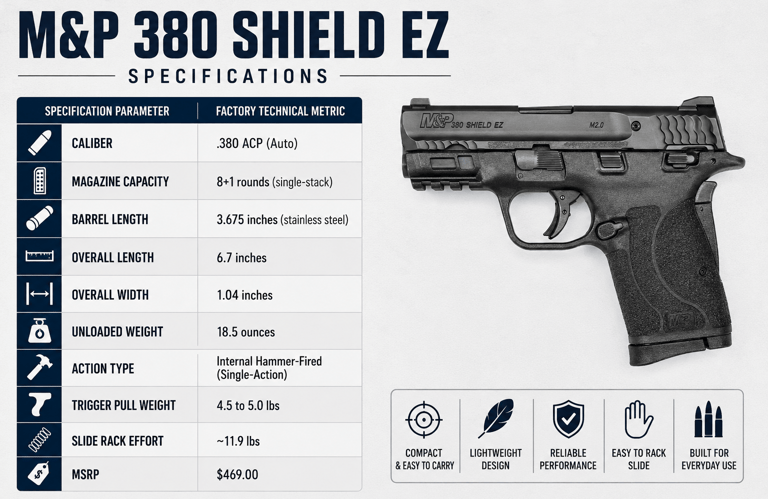
The M&P 380 Shield EZ features a 3.675-inch barrel, with an overall length of 6.7 inches, an unloaded weight is about 18.5 ounces, and has a 8+1 single-stack capacity in .380 ACP. Equipped with a polymer frame, stainless steel slide with an Armornite finish, and a tactile loaded chamber indicator, it also delivers full sized grip ergonomics in a slim 1.04 inch profile.
Here is how those factory dimensions stack up against common carry guns:
How Does the M&P 380 Shield EZ Perform on the Range?
In our range testing, going through several hundred rounds of mixed ammunition, the M&P 380 Shield EZ demonstrated exceptional reliability with zero failures, manageable recoil, and average 15 yard group sizes under 3 inches. Its low pressure chambering and it's full three finger polymer grip allowed the firearm to return to sight alignment almost instantaneously during our rapid fire test.
What I found when I tested this pistol at 15 yards was also how forgiving it is during continuous fire. Many compact .380 pistols rely on a direct blowback design that creates a surprisingly sharp and snappy push into the palm. By using a short recoil locked breech system instead, the Shield EZ dampens the energy transfer so effectively that muzzle flip feels closer to a target .22 LR pistol than a centerfire personal defense tool.
During precision tracking, I ran three different ammunition types over a chronograph and measured bench rest grouping accuracy:
Federal Premium HST 99-grain JHP: Averaged 1,010 fps with an average 15-yard group size of 2.3 inches.
Blazer Brass 95-grain FMJ: Averaged 930 fps with an average 15-yard group size of 3.1 inches.
Underwood Xtreme Defender 68-grain: Averaged 1,150 fps with an average 15-yard group size of 2.6 inches.
Between strings of fire, those load assist tabs saved a lot of hassle. Just pull the side stud down with your support thumb and drop rounds straight into the mag no speed loader needed.
What Are the Main Pros and Cons of the M&P 380 Shield EZ?
The primary benefits of the M&P 380 Shield EZ include its effortless slide manipulation, soft recoil impulse, crisp 4.5-lb trigger, and easy-loading magazines. Its drawbacks are restricted capacity capped at 8+1 rounds, a slightly larger frame footprint than micro-nine handguns, and a raised rear grip safety that requires a firm, positive hand hold.
Before purchasing, weigh these operational advantages and potential trade-offs:
Key Advantages:
Minimal Racking Force: Requires roughly 12 lbs of pull effort, making it accessible for users with severe grip weakness. I have abused my hands through the years and developed arthritis at a fairly young age. Though I am still able to rack the average slide, I do feel it after a while at the range. The M&P Shield EZ comes on the other hand is pretty much a two finger operation and pleasant to operate.
Tool-Free Magazine Loading: Built-in side pull-down tabs prevent thumb fatigue during extended range sessions.
Smooth Ergonomics: The 18-degree grip angle and textured polymer surface provide natural point-of-aim alignment.
Integrated Rail Space: Features a standard Picatinny accessory rail for compact tactical lights or aiming lasers.
Notable Disadvantages:
Limited Capacity: Holds 8+1 rounds, whereas modern double-stack micro-compacts carry 10 to 13 rounds.
Grip Safety Sensitivity: Shooters with high, weak-hand grips may occasionally fail to depress the grip safety fully if their hand placement slips.
Larger Carry Footprint: At 6.7 inches long, it is harder to deep-conceal than micro .380 pocket pistols.
My Perspective: Is the M&P 380 Shield EZ Worth Buying?
In my experience with handguns, it seems that the firearms industry spent decades ignoring a massive demographic: shooters who physically struggle to operate heavy recoil springs. The M&P 380 Shield EZ wasn't designed to compete with high-capacity micro-9mm handguns for tactical shooters—it was engineered to give individuals independence and a little extra confidence in their home defense setup.
What stood out most during my testing wasn't just how light the slide felt, but how reliable the gun remained despite those soft springs. Low-tension semi-autos often suffer from failure-to-feed or extraction issues when a shooter "limp-wrists" the gun, but the Shield EZ's locked-breech geometry swallows varying bullet profiles without stuttering.
If you have normal hand strength and want maximum rounds per inch, a higher-capacity micro-compact might fit your EDC layout better. However, if hand pain, arthritis, a weaker grip or reduced finger leverage makes clearing a slide difficult, the M&P 380 Shield EZ remains one of the most practical, user-friendly defensive pistols on the market today. This is my wife's choice in an everyday carry because she lacks the hand strength to rack a slide easily and this pistol gives her the confidence she needed to carry a firearm that she knew she could operate with ease in a defensive type situation.
Frequently Asked Questions About the M&P 380 Shield EZ:
Can you rack the slide on the M&P Shield 380 EZ with one hand?
Yes, the slide requires only about 12 pounds of force to manipulate, and the enlarged rear slide serrations provide extra purchase against a belt or holster body for one-handed operation.
Is the M&P 380 Shield EZ good for concealed carry?
Yes, with an overall width of 1.04 inches and an unloaded weight of 18.5 ounces, it carries comfortably in inside-the-waistband (IWB) or outside-the-waistband (OWB) holsters, though its grip length is slightly taller than standard pocket pistols.
Does the M&P Shield 380 EZ require a tool to disassemble?
No, field stripping the M&P 380 Shield EZ does not require pressing the trigger or using specialized tools; simply lock the slide back, rotate the takedown lever downward, and slide the assembly forward.
What is the difference between the Shield EZ .380 and the Shield EZ 9mm?
The .380 ACP version is lighter (18.5 oz vs 23.2 oz), noticeably softer shooting, and slightly easier to rack than the 9mm version, while both share identical 8+1 magazine capacities and operating controls.
Subscribe newsletter
or Email us at: DerringerDan@Snakebite.com
For Advertising information: 941-876-8332
425 Montague ln. Northport, FL 34287