How to Choose the Right Firearm: A Buyer's Guide
Need help to choose the right firearm? Discover how purpose, hand fit, caliber, reliability, and firsthand range experience can help you make the best choice.
OPINION
Dan
6/29/20266 min read


So you've decided you want to buy a firearm. Maybe it's for home defense. Maybe you want to get into sport shooting. Maybe you just moved somewhere rural and it finally makes sense to have one around. Whatever your reason, you're probably staring at a wall of options — pistols, revolvers, shotguns, rifles — and thinking: where do I even start?
Here's the good news: choosing the right firearm doesn't have to be overwhelming. Once you know what to look for, the decision gets a lot clearer. This guide will walk you through the most important factors — purpose, size and fit, caliber, action type, and budget — so you can choose a firearm with confidence and walk out of the shop feeling great about it.
Start With Purpose: What Do You Actually Need It For?
This is the single most important question, and it shapes everything else. A firearm you'll carry concealed every day has totally different requirements than one sitting in a bedside drawer or one you're taking to the range on weekends.
Here are the most common use cases:
Home defense: You want something reliable, easy to operate under stress, and powerful enough to stop a threat. Full-size pistols, revolvers, and shotguns are all popular choices here.
Concealed carry: Size and weight matter a lot. You'll probably be looking at compact or subcompact pistols that balance concealability with enough rounds to feel secure.
Sport shooting and target practice: Comfort and accuracy over long sessions matter more than size. This is where ergonomics and trigger quality really shine.
Hunting: Caliber and range are the big factors. What you're hunting — deer, hogs, birds — determines a lot of the answer.
Don't try to find one gun that does everything perfectly. It's a classic trap. Pick the primary use case and optimize for that.
Handgun, Shotgun, or Rifle? Picking the Right Platform
Once you know your purpose, you can start narrowing down the platform — that is, the general type of firearm.
Handguns (pistols and revolvers) are the most versatile option for personal defense and everyday carry. They're compact, relatively easy to store safely, and manageable for most people to learn on. Pistols hold more rounds; revolvers are simpler to operate and extremely reliable.
Shotguns are a classic home defense option. A 12-gauge pump-action is hard to argue with — it's intimidating, effective at close range, and relatively forgiving of aim. They're also excellent for hunting birds and small game. The downside: they're large, the recoil can be stout, and they're not practical to carry.
Rifles offer superior range and accuracy. If you're hunting, shooting at longer distances, or want an all-around option for rural property defense, a rifle makes a lot of sense. They tend to be louder and less maneuverable indoors, so they're rarely the first pick for home defense in urban or suburban settings.
Fit and Feel: Why Handling Guns Before You Buy Is Non-Negotiable
Here's something a lot of first-time buyers skip — and then regret. You need to hold a gun before you buy it. Preferably shoot it.
Firearms aren't one-size-fits-all. Hand size, grip strength, and even the length of your fingers affect how naturally a gun points for you and how confidently you can reach the controls. A full-size pistol might feel awkward and heavy to someone with smaller hands, while a compact model might feel like a toy to someone larger.
When you visit a gun store or range, ask to handle a few different options. Notice:
Does the grip fill your hand comfortably without feeling oversized?
Can you reach the trigger with the pad of your finger (not the joint) without shifting your grip?
Can you operate the safety, mag release, or slide without contorting your hand?
Does the weight feel manageable for extended carry or use?
Many ranges rent firearms, which is a fantastic way to actually shoot a few options before committing. It's one of the best investments of $20–$30 you can make in this process.
Caliber: Balancing Stopping Power and Recoil
Caliber refers to the diameter of the bullet, and it's one of the most debated topics in the firearms world. Here's a practical way to think about it without getting lost in the weeds.
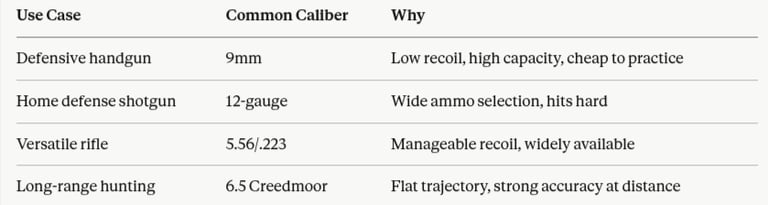
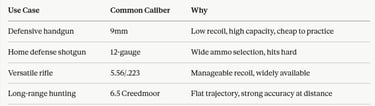
For handguns, the most common self-defense calibers are 9mm, .40 S&W, and .45 ACP. Of these, 9mm has become the dominant choice for good reason — modern ammunition has closed most of the performance gap with larger calibers, it produces less recoil, magazines hold more rounds, and it's cheaper to practice with.
For shotguns, 12-gauge is the standard for most purposes. It hits hard, ammo is widely available, and there's a huge variety of loads for different applications. If recoil is a concern, a 20-gauge is a reasonable step down.
For rifles, caliber depends heavily on use. 5.56/.223 is common for sport shooting and versatile defensive use. 6.5 Creedmoor has become hugely popular for hunting due to its accuracy at distance. 30-06 and .308 are tried-and-true hunting rounds that have been working for generations.
The bottom line: don't obsess over finding the "most powerful" option. A caliber you can shoot accurately and comfortably will always outperform one that beats you up at the range.
Action Type: Semi-Auto, Revolver, or Pump — Which Should You Choose?
Semi-automatic firearms cycle automatically and offer higher capacity and faster follow-up shots, while revolvers and pump-actions are manually operated, simpler mechanically, and often more forgiving of neglect. Beginners drawn to absolute reliability often do better with a revolver or pump-action; those prioritizing capacity and speed usually land on semi-auto.
A quick comparison:
Semi-auto pistol: higher capacity (12–17+ rounds), faster reloads, more moving parts
Revolver: 5–6 rounds, extremely simple, very hard to malfunction
Pump shotgun: manual cycling, mechanically dead-simple, widely trusted
Bolt-action rifle: manually operated, the gold standard for hunting accuracy
I've seen this go wrong when new owners buy a semi-auto and never train on clearing a malfunction — when (not if) one happens at the range, they freeze. If you're not committed to training, a revolver removes that failure point almost entirely.
Budget: What Should You Expect to Spend?
Quality firearms exist across a wide price range, but it pays to have realistic expectations.
For a reliable handgun, budget $400–$700 for a trusted name like Glock, Smith & Wesson, Ruger, or Sig Sauer. You can find decent options under $400, but reliability should never be where you cut corners on a defensive firearm.
A solid home-defense shotgun — like a Mossberg 500 or Remington 870 — can be had for $300–$500, which makes them one of the most affordable capable options out there.
Entry-level rifles start around $500–$800 and go up quickly from there depending on the platform and purpose.
Don't forget to budget for: a quality safe or secure storage, ammunition for practice, a cleaning kit, and any training courses you plan to take. Responsible ownership goes hand-in-hand with the purchase itself.
Making the Final Call
Choosing the right firearm comes down to honest answers to a few key questions: What do I need it for? What feels right in my hand? What can I shoot accurately and comfortably? And what fits my budget?
Take your time. Visit a good local gun shop where the staff are patient and knowledgeable. Rent and shoot a few options if you can. And once you've made your choice, invest in proper training — it's the single best thing you can do as a new gun owner.
The right firearm is the one that fits your life, your hands, and your needs. You've got everything you need to find it.
Buying a First Firearm FAQ:
What is the best firearm for a complete beginner?
A compact 9mm striker-fired pistol or a medium-frame .38 Special revolver is typically best for beginners. These platforms offer a clean learning curve, straightforward controls, and enough weight to keep recoil manageable during training.
Is a revolver better than a semi-automatic for home defense?
Semi-automatics are generally preferred because they offer higher ammunition capacity, faster reloads, and less felt recoil. However, revolvers offer simple operation and are less susceptible to malfunctions caused by a weak grip.
Do I need a permit to buy a firearm?
Requirements vary significantly by state and country, including background checks, waiting periods, and permits — always check your specific local and state laws before purchasing.
How much should I budget for my first firearm?
Plan for $400–$700 for a quality handgun or $300–$500 for a home-defense shotgun, plus additional budget for a safe, ammunition, and a training course.
Should I buy a gun online or in person?
First-time buyers should buy in person whenever possible so they can physically handle the firearm before committing; online purchases still require transfer through a licensed local dealer in most jurisdictions.
Subscribe newsletter
or Email us at: DerringerDan@Snakebite.com
For Advertising information: 941-876-8332
425 Montague ln. Northport, FL 34287