
The Versatile Powerhouse: A Guide to .22 Magnum Ammunition
Explore the power of .22 Magnum ammunition. Compare .22 Magnum vs. .22 LR velocity, energy, and range to find the perfect rimfire round for hunting and sport.
AMMUNITION
Dan
1/4/20264 min read
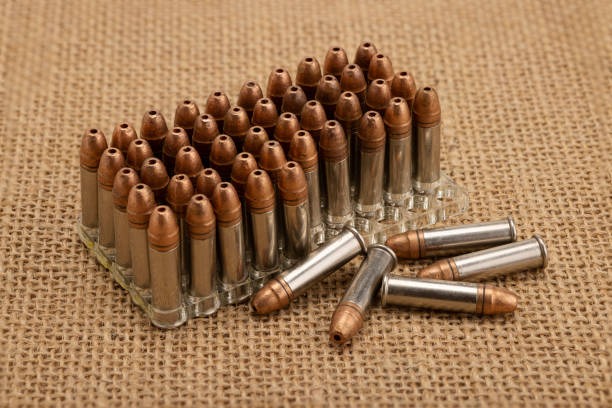
The world of rimfire cartridges is often dominated by the ubiquitous .22 Long Rifle, but for those seeking more punch, flatter trajectories, and greater effective range, the .22 Magnum stands in a league of its own. Formally known as the .22 Winchester Magnum Rimfire (.22 WMR), this cartridge has carved out a permanent niche among hunters, target shooters, and even those looking for a lightweight self-defense option.
In this guide, we will dive deep into the mechanics of .22 Magnum rounds, analyze their impressive velocity and power, and perform a head-to-head comparison with the standard .22 LR to see why this "magnum" designation is well-earned.
What is .22 Magnum? History and Design
Introduced by Winchester in 1959, the .22 Magnum was designed to bridge the gap between small-game rimfire rounds and centerfire cartridges like the .222 Remington. Unlike the .22 LR, which was an evolution of older black powder designs, the .22 WMR was built from the ground up to handle higher pressures.
The case is longer and thicker than the .22 LR, and more importantly, the bullet is "jacketed." While most .22 LR rounds use lubricated lead, the .22 Magnum utilizes copper-jacketed bullets. This allows it to handle much higher velocities without "leading" the barrel (leaving lead deposits that degrade accuracy).
.22 Magnum Power and Velocity: Breaking Down the Numbers
When people talk about the .22 Magnum, the first thing they mention is speed. While a standard high-velocity .22 LR might travel at 1,200 feet per second (fps), the .22 Magnum routinely pushes those boundaries.
Average Velocity Specs
Depending on the barrel length (rifle vs. handgun) and the grain weight of the bullet, you can expect the following:
30-Grain Bullets: These "varmint tips" can reach velocities of 2,200 fps out of a rifle.
40-Grain Bullets: The standard weight for the caliber typically clocks in at 1,850 to 1,900 fps.
50-Grain Bullets: Heavier rounds designed for better penetration usually travel at roughly 1,500 to 1,600 fps.
Kinetic Energy and Stopping Power
Velocity is only half the story; the other half is energy. The formula for kinetic energy emphasizes velocity (squaring the velocity), which gives the .22 Magnum a massive advantage.
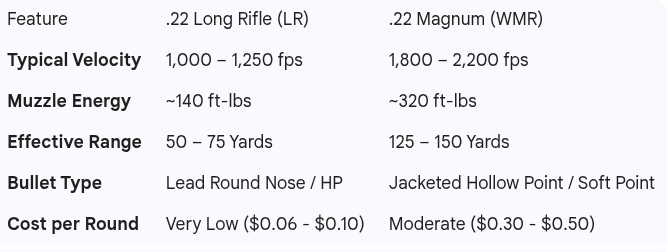
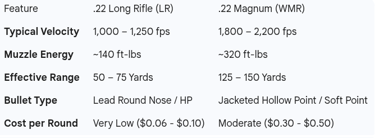
A standard .22 LR produces about 130 to 140 foot-pounds (ft-lbs) of energy at the muzzle.
The .22 Magnum produces between 300 and 325 ft-lbs of energy.
This effectively doubles the "punch" of the round, making it viable for larger small-game animals like coyotes, foxes, and large raccoons at distances where a .22 LR would simply fail to provide a clean, ethical kill.
.22 Magnum vs. .22 LR: A Power Comparison
If you are deciding between these two rounds, it’s important to understand that while they share the ".22" name, they are not interchangeable. You cannot fire .22 Magnum in a .22 LR chamber, and doing the reverse is dangerous and inaccurate due to the difference in case diameter.
1. Trajectory and Range
The .22 Magnum shines in its "flatness." Because it travels so much faster, it doesn't succumb to gravity as quickly as the .22 LR. If you sight in a .22 LR at 50 yards, the bullet will drop significantly by the time it reaches 100 yards. A .22 Magnum, however, stays relatively flat out to 100 yards, making it a much more effective "varmint" tool for open fields.
2. Terminal Performance
Because of the copper jacket, .22 Magnum bullets are designed to expand or fragment upon impact. The .22 LR often simply deforms. For hunters, this means the .22 Magnum creates a much larger temporary wound cavity, which is essential for stopping pests quickly and humanely.
Practical Applications for .22 Magnum Rounds
Why choose the .22 Magnum over a centerfire round like the .223 Remington? It often comes down to the "Goldilocks" principle: it's more powerful than a .22 LR but quieter and less destructive to meat/pelts than a centerfire rifle.
Varmint Hunting: It is arguably the perfect "farm gun" caliber. It can handle woodchucks, prairie dogs, and coyotes at 125 yards without the massive report of a larger rifle.
Self-Defense (Handguns): While not a primary choice for many, the .22 Magnum has gained popularity in ultra-lightweight snub-nosed revolvers. It offers significantly more penetration than a .22 LR with very manageable recoil for those with hand strength issues.
Survival Scenarios: Because the ammunition is still relatively small, you can carry hundreds of rounds in a backpack. It provides enough power to take down small to medium game for food in a pinch.
Choosing the Right .22 Magnum Ammo
Not all .22 Magnum rounds are created equal. Your choice should depend on your firearm and your intent:
For Varmints: Look for polymer-tipped rounds (like the Hornady V-MAX). These are designed for explosive expansion upon impact.
For Target Shooting: Standard 40-grain Total Metal Jacket (TMJ) rounds are generally the most consistent and affordable.
For Short Barrels: If you are shooting from a handgun, look for "short barrel" specific loads. These use faster-burning powders to ensure you get maximum velocity before the bullet leaves the shorter barrel.
Final Thoughts
The .22 Magnum is a testament to how much performance you can squeeze out of a rimfire platform. It offers a significant step up in power, velocity, and effective range over the .22 LR, filling a vital gap for shooters who need more "oomph" without transitioning to the cost and noise of centerfire cartridges.
Whether you are protecting your livestock from predators or looking for a high-performance plinker, the .22 Magnum remains one of the most versatile rounds in the shooting world.
Subscribe newsletter
or Email us at: DerringerDan@Snakebite.com
For Advertising information: 941-876-8332
425 Montague ln. Northport, FL 34287